
Yucai rigid packaging, thanks to its excellent strength and luxurious appearance, has become a popular choice for certain products. Due to its weight and high cost, it is also referred to as a collector's box, premium packaging, or high-end packaging.
What Are Set-Up Boxes?
Custom rigid boxes are sturdy paper packaging made from thick fiberboard panels (typically 2 to 3 mm) coated with special decorative paper. As mentioned earlier, due to their luxurious appearance and texture, these boxes are often referred to as "high-end cases" or premium packaging, ideal for board games, jewelry, other luxury items, or gifts.
In addition, these customized boxes offer a refined touch of elegance, enhance the customer's opening experience, and create more opportunities to build a strong brand narrative. Thanks to various customization options—such as printing and surface treatments—they enable diverse and rich brand presentations, including Hot stamping, embossing/debossing, coating, and decorative elements.
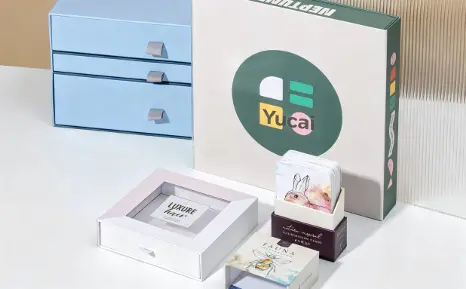
The Difference Between Corrugated, Folding Cartons, and Custom Rigid Boxes
If you've already studied and understood various types of packaging suitable for your product, you may have heard about other options such as flexible packaging, corrugated cardboard, or folding cartons. At first glance, you might be able to discern the difference between rigid and flexible packaging, but distinguishing between corrugated cardboard and folding cartons can be more challenging. However, to cover all possible options, let's briefly review each choice and its differences.
First of all, rigid boxes are sturdy, weight-resistant, and offer a relatively high-end appearance and texture. This type of packaging is highly popular, made from thick fiber panels, providing a full, compact solution that resists deformation—clearly contrasting with flexible packaging, which is more pliable and easier to fold.
However, when examining other options, the distinction becomes slightly more complex, as they are very similar. Although rigid cardboard boxes are often perceived as distinctive due to their appearance, some popular alternatives include folding cartons and high-end corrugated packaging, widely appreciated for their cost-effectiveness, as well as their flexibility in high-quality printing and surface finishing. Let's now examine the differences between these two types:
| Rigid Boxes | Folded Carton Boxes | Corrugated Boxes | |
| Set up | None if not foldable | Needed | Needed |
| Sturdiness | High | Low | High |
| Product Safety | High | High with the aid of inserts | High |
| Cost | Generally High | Depends on printing & finish | Depends on printing & finish |
| Appeal | Generally High | Depends on printing & finish | Depends on printing & finish |
| Reusable | Yes | Usually not | Yes |
Types Of Packaging
There are two types of custom rigid cartons: partially lined cartons and fully lined cartons.
Partially lined cartons refer to packaging where the wrapping paper and particle board are treated only partially. In this case, the wrapping paper covers the outer surface of the box, while the particle board remains visible. For partially lined boxes, a particle board with a perforated folding line is used for folding and framing, eliminating the need for an additional external component and thus avoiding direct contact with kraft paper or gray particle board.
This option is preferred as it significantly reduces the amount of material required during production, greatly shortening manufacturing time.
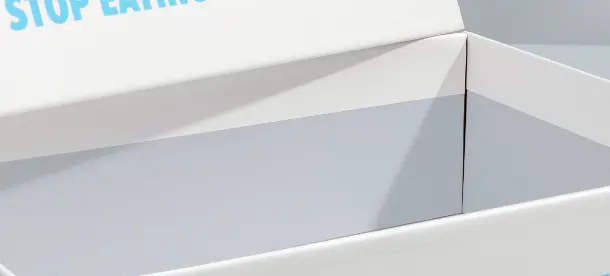
On the other hand, full coverage treatment hides the plywood, and the packaging completely covers the box. This option uses a thicker plywood, 2 to 3 mm thick, with the inner layer divided into several sections assigned to the two sides of the box. Depending on requirements, various surface finishing techniques can be selected to achieve a plastic coating.
The complete packaging also includes an additional wrapping layer, typically white or printed with a pattern.
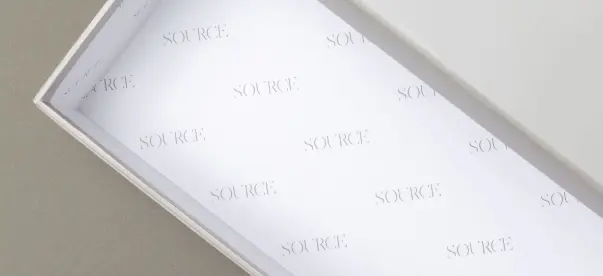
Various High-End Packaging Styles
Tube or rolled-edge tube packaging is a cylindrical packaging form with an expandable or shoulder-neck opening design, making it ideal for beverages, cosmetics, accessories, and snack containers such as Pringles cans.
The magnetic closure box features two sturdy magnets that easily seal the container, adding a touch of luxury to jewelry and retail products. Its touch-sensitive closure design also allows the box to be folded for convenient storage, offering simple use and easy keeping.
Drawer boxes, as the name suggests, open like a drawer. They are also known as sliding boxes, slide drawers, or matchbox containers.
The book-style box opens like a hardcover volume, adding a touch of creativity and innovation. Whether with a right-hand or rounded design, it offers an authentic book-like texture. It can also be paired with magnetic accessories to create a luxurious packaging option.
Inserts To Compliment Styles
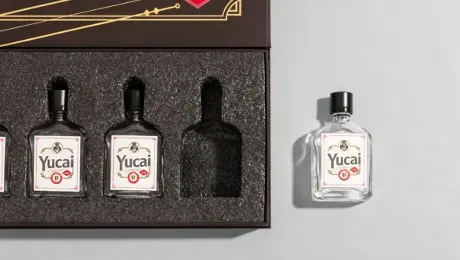
The style options for rigid boxes are endless, but once the desired type is chosen, the next step is to consider the interior material to be used. When designing rigid packaging, additional materials such as inner liners are highly valued. For an optimal opening experience, we strongly recommend using an inner lining.
The Pros And Cons Of Boxes
Advantages
-Sturdy, shock-resistant structure paired with custom foam inserts to safeguard goods during rough transit.
-Premium, luxurious texture that outperforms regular folding cartons and corrugated boxes.
-Reusable design; customers tend to retain the boxes long-term instead of discarding them.
-Elevates brand value drastically. The rigid box and product are perceived as a complete high-end set, making it the top pick for gift packaging.
Disadvantages
-Poor durability for oversized products: Wrapping paper edges tear easily under heavy weight, requiring thicker laminated paper for extra strength.
-Higher production cost: Up to 3 times pricier than folding or corrugated boxes.
-Longer lead time: Hand-assembled with strict manual QC, taking 1–2 weeks more to produce than standard packaging.
Final Thoughts
Understanding the differences between each box type allows you to make an optimal choice for your brand. The right box not only supports your design but also conveys quality and tells the story of your brand.
If you're still unsure, the Yucai packaging team is available at any time. We can provide professional advice and samples to help you find the most suitable packaging solution.
FAQ
1. What is the MOQ for custom boxes?
No MOQ, more quantity, lower unit price.
2. Can I order a sample before mass production?
Yes. Yucai provides samples so you can check size, material, print quality, and overall appearance before placing a large order.
3. How long does production usually take?
Production time depends on customization and order quantity. Standard orders may take 7–15 business days, while complex designs can take longer.
4. Will custom boxes increase shipping costs?
Not necessarily. Choosing the right size and lightweight materials can help reduce unnecessary shipping expenses.
5. Can I customize the box size for my products?
Yes. Custom sizing is available to better fit products, reduce movement during shipping, and improve presentation.
6. Are custom boxes suitable for international shipping?
Yes, but material strength and box structure should match shipping distance and product fragility.
7. Can I reorder the same packaging design later?
Yes. Yucai saves design files and specifications, making future reorders faster and more consistent.
Post time: Jul-20-2026